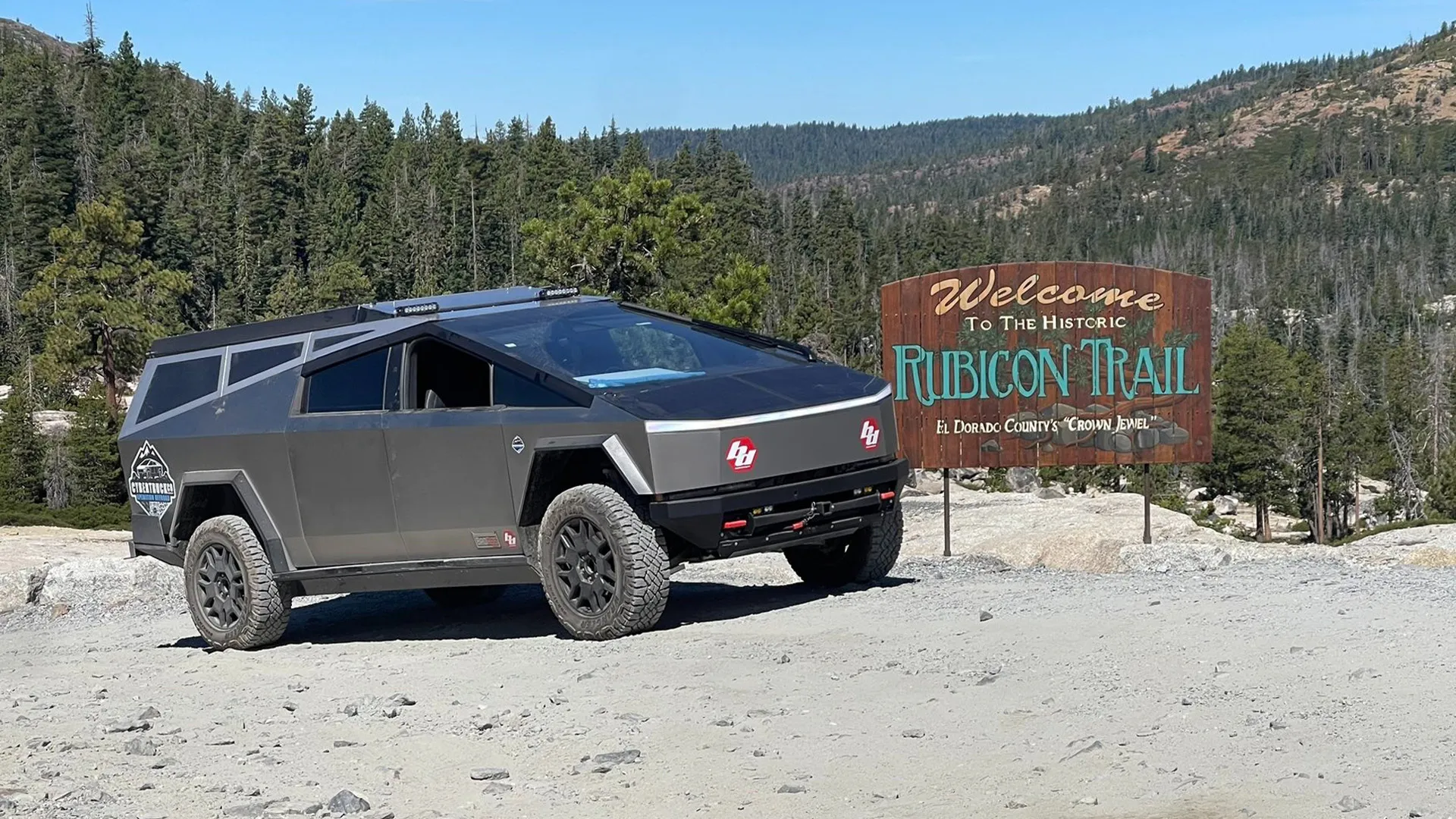
The Tesla pickup that became famous for sitting immobilized on the Rubicon Trail for days has finally completed its journey barely. More than a week after the attempt began, the owner is sharing the full story behind one of the most punishing EV off-road tests to date.
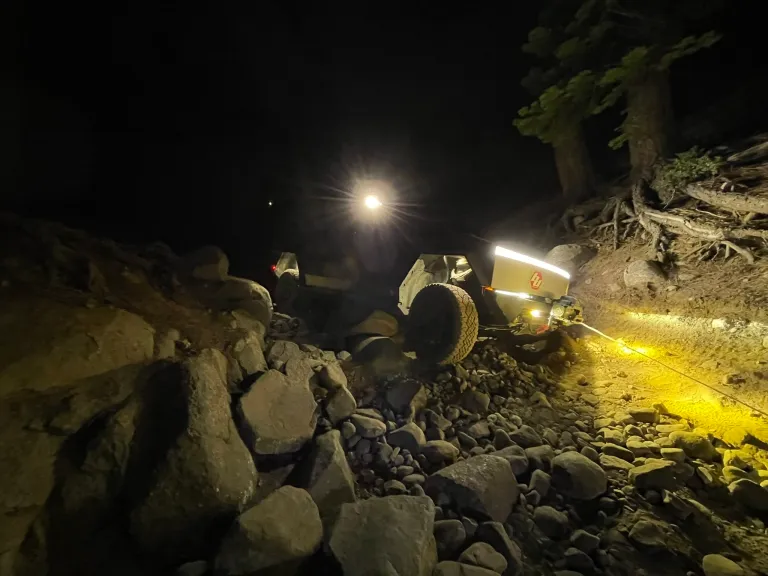
When photos and videos of a disabled Tesla Cybertruck appeared across Facebook groups and automotive forums earlier this week, they quickly went viral. The electric pickup had been stranded on the Rubicon Trail-a place known for humbling even modified gas-powered rigs-for several days. The situation involved multiple broken components, a forced repair in the dirt, and a makeshift anchoring job on Cadillac Hill.
Now, after finally reaching the Tahoma staging area with only bruises (and many bent tie rods), the Cybertruck’s owner, Roger Davis, is speaking out about what actually happened during his week-long ordeal. And according to him, the dramatic images only tell part of the story.
A Trail Known for Destroying Vehicles
The Rubicon Trail is one of the most challenging off-road routes in North America-a 22-mile gauntlet of granite boulders, steep ledges, tight passages, and relentless technical obstacles. Even purpose-built rock crawlers on 37- or 40-inch tires approach the trail with caution, and full-size vehicles often need significant modifications before attempting it.
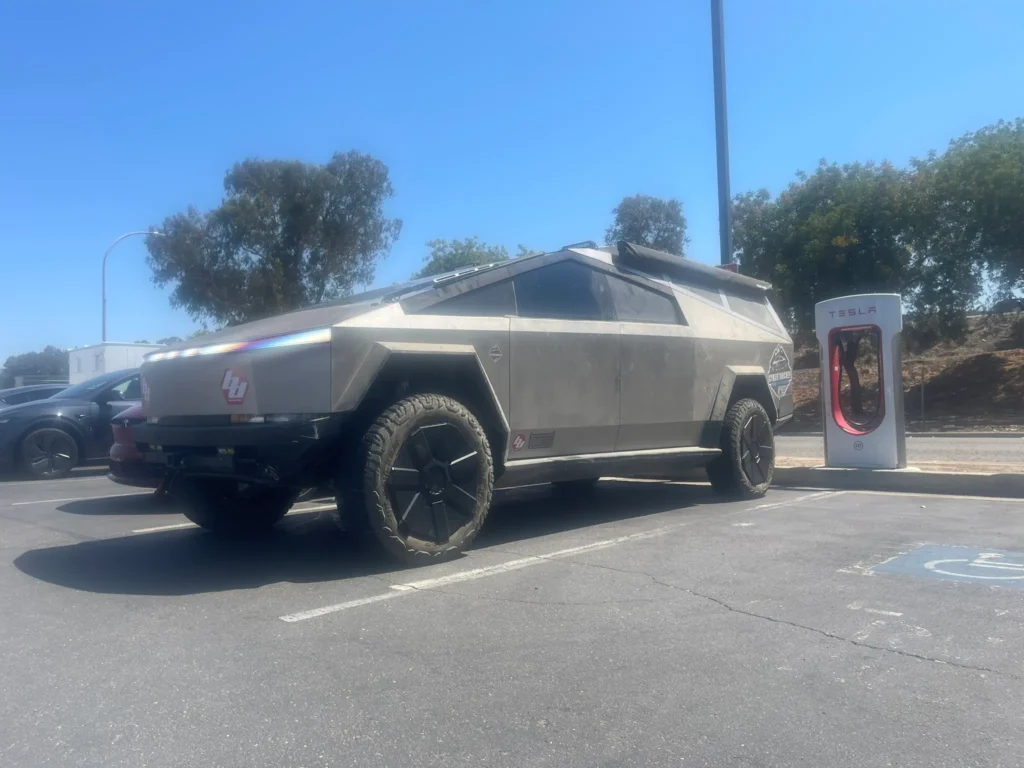
Despite that, Davis wanted to prove that a lightly modified Tesla Cybertruck-the vehicle that symbolizes the cutting edge of electric pickup capability-could survive one of the most punishing off-road environments in the world.
“First of all, the Cybertruck should never cross the Rubicon without a skilled team of techs and spotters who know the trail well,” Davis said. “You also need to come with spares and be prepared.”
His warning now reads less like advice and more like a hard-earned confession.
A Support Jeep, High Hopes, and Rising Problems
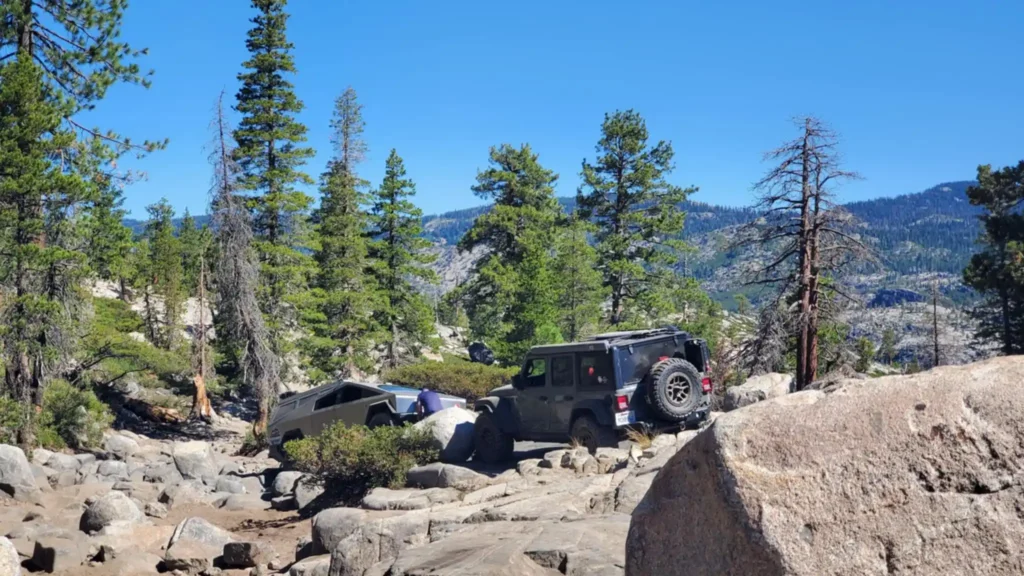
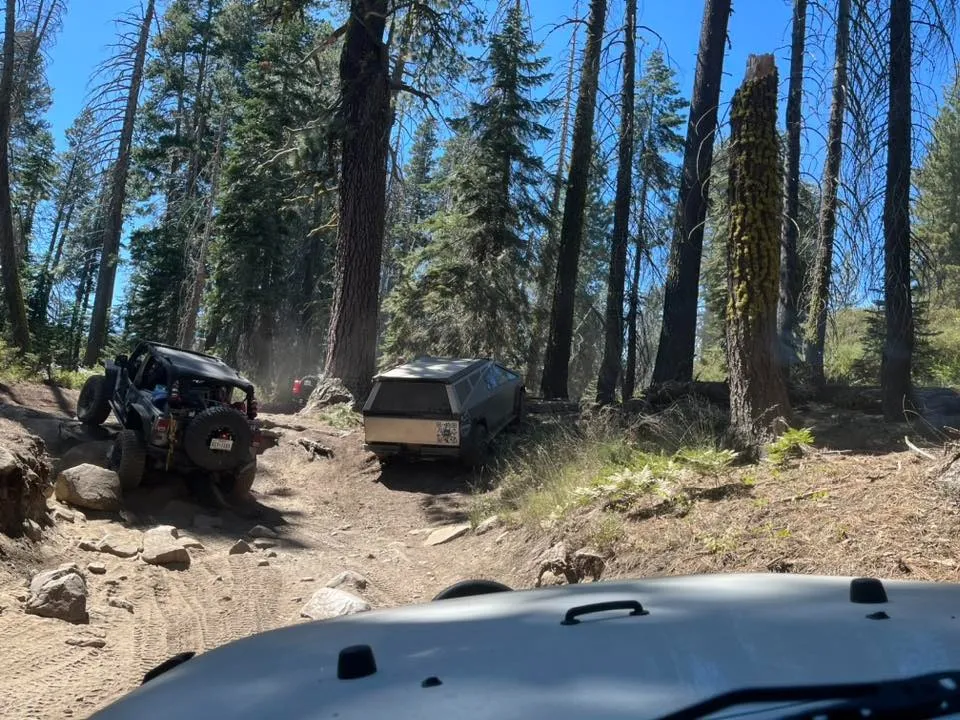
Davis didn’t go alone. He invited a four-door Jeep Wrangler JL Rubicon to accompany the Cybertruck during the attempt. That Wrangler became a crucial lifeline-and ultimately the vehicle that did a significant amount of towing.
While many off-roaders on the trail reported seeing the Jeep repeatedly pulling the Cybertruck through obstacles, Davis remains adamant that the EV held its own.
According to him, the truck was outfitted with practical upgrades:
- Rock sliders
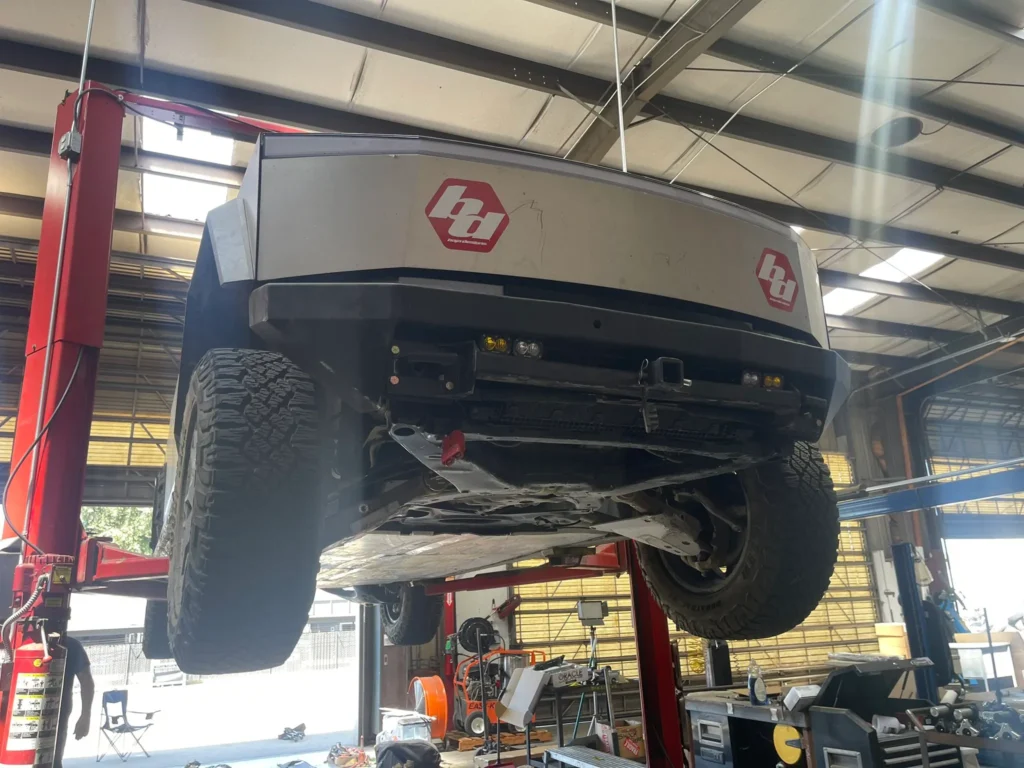
- Front and rear aftermarket bumpers
- Full-length skid plating
- OEM Goodyear tires
- A mild one-inch lift
“It didn’t have any trouble on most obstacles,” he said. “We never held up the trail, and we did well with great spotting. And yes, of course, we pulled line and tugged it over some of the harder stuff-just like you would do for any other vehicle on this trail.”
Davis even points out that they passed other broken vehicles, including:
- A disabled Suzuki Samurai
- Two struggling Jeep Wranglers
- A Ford Bronco experiencing its own mechanical issues
“The Cybertruck definitely wasn’t the only rig that took damage out there,” he insisted.
Tie Rod Carnage, a Busted Steering Rack, and a CV Axle Failure
However, the Tesla did suffer a long list of mechanical failures-far more than a typical Rubicon attempt.
The Cybertruck sustained:
- Four bent front inner tie rods
- Two damaged rear tie rods (one bent, one with a sheared M14 bolt)
- A destroyed rear CV axle on Cadillac Hill
- A catastrophically failed steering rack
Davis says they improvised one repair using a wheel spacer bolt to replace the sheared M14 bolt. But the steering rack failure was a major setback. It left the truck immobile on one of the steepest, narrowest, and most unforgiving portions of the Rubicon.
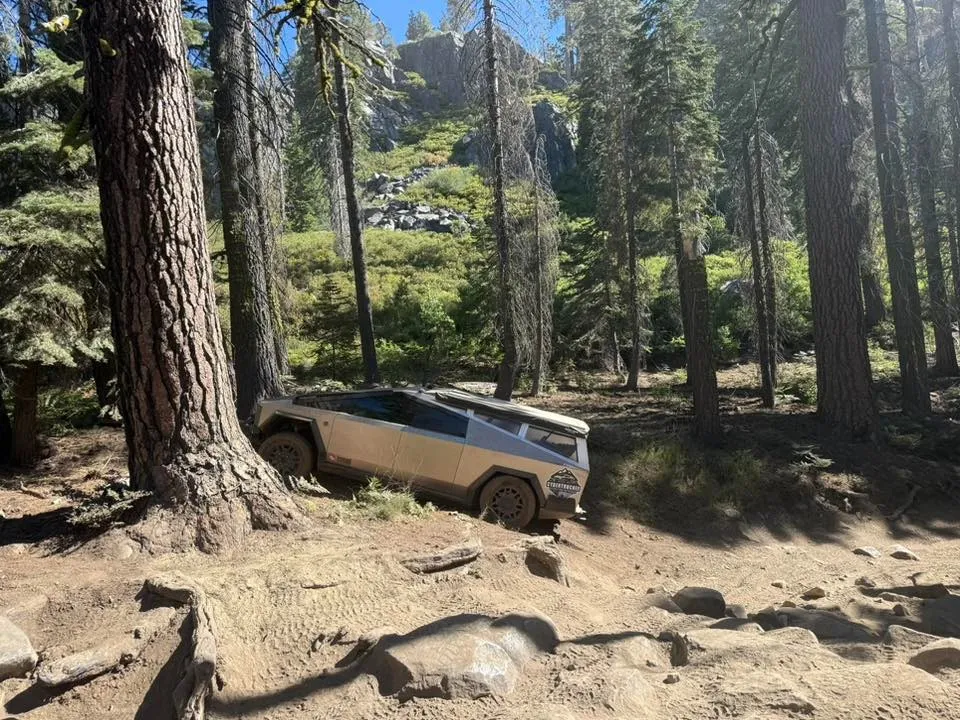
“We were able to acquire a new front steering rack and a new rear axle,” Davis explained. “We replaced those in the dirt with the truck up on that tree.”
That tree-the one seen in many viral photos-was used as an anchor to lift and stabilize the electric pickup during repairs.
“As soon as she was back on the trail, she immediately climbed up that obstacle,” Davis recalled. “We got to the top, took some more pictures, and completed the rest of the trail easily.”
The “easy” part, of course, came after four days of being stuck on Cadillac Hill.
Energy Problems on the Trail: A Charging Crisis
Even once the mechanical failures were addressed, the Cybertruck faced another life-or-death challenge: battery charge.
Davis believes the truck might have been able to finish the entire route on a single charge if they had started at 100%. But they began at around 85%, and the slow crawling on granite-combined with power demands from winching and accessory use-drained the battery much faster than expected.
By the time the Cybertruck rolled into Rubicon Springs, it had only 5% state of charge remaining.
The campsite’s Yamaha generators were too small to make any meaningful progress.
Then, unexpectedly, help arrived.
“A guardian angel brought a larger unit and was able to fill the battery to 86%,” Davis said. “That let us finish the run.”
That anonymous good Samaritan likely saved the entire attempt from ending in a dead-battery evacuation.
A Word of Warning-from Someone Who Survived It
Now safely home, Davis feels compelled to offer a blunt message to anyone considering following in his tire tracks.
“I do not recommend any person trying the Rubicon with a Cybertruck unless you come extremely prepared,” he warned.
Yet he also pushed back on a recurring criticism about EVs on difficult trails:
“There’s probably less chance of this EV burning down that forest than all of the fossil fuel vehicles running through there,” he said.
For Davis, the Rubicon run was a “bucket list” challenge. And now that it’s done, he doesn’t plan to rush back.
“It’s checked off the bucket list, and we likely won’t go back anytime soon.”
A Divisive Attempt in a Divisive Vehicle
Predictably, the Cybertruck’s Rubicon journey ignited fierce debate. Some wheelers argued he never should have attempted the trail with an electric pickup of that size and weight. Others cheered him on and admired the determination to push EV capabilities into territory typically reserved for highly modified gas-powered crawlers.
Davis says that in person, many off-roaders along the trail encouraged him to keep going-even when the truck was immobilized. But online commentary was far more polarized.
Still, he remains unfazed.
“As far as I’m concerned, the Tesla Cybertruck is the only vehicle in the world that can say it drove me with my hands off the steering wheel from San Diego all the way to the trailhead,” he said. “It then crossed the trail, and when it got off, it immediately started the journey home again, using Full Self-Driving while I read all the comments.”
A Happy Ending-And a Reality Check for EV Off-Roading
Davis has the Cybertruck back in his driveway now-a better outcome than many expected during the lowest points of the journey. The truck suffered severe component failures, endured one of the toughest off-road trails in existence, and still managed to exit under its own power.
And, importantly, they never had to call in a helicopter for extraction-something that has happened with other stranded vehicles on the Rubicon.
The ordeal highlights both the potential and the limitations of electric pickups in extreme off-road environments. While instant torque, quiet operation, and advanced traction control are undeniable advantages, the Rubicon Trail exposed vulnerabilities in steering, suspension durability, and long-distance energy management under extreme load.
For Tesla, off-road engineers, and EV enthusiasts, Davis’ journey provides invaluable real-world insight into how electric trucks behave under true rock-crawling punishment-insight that no simulation or press demonstration can replicate.
Leave a Reply